
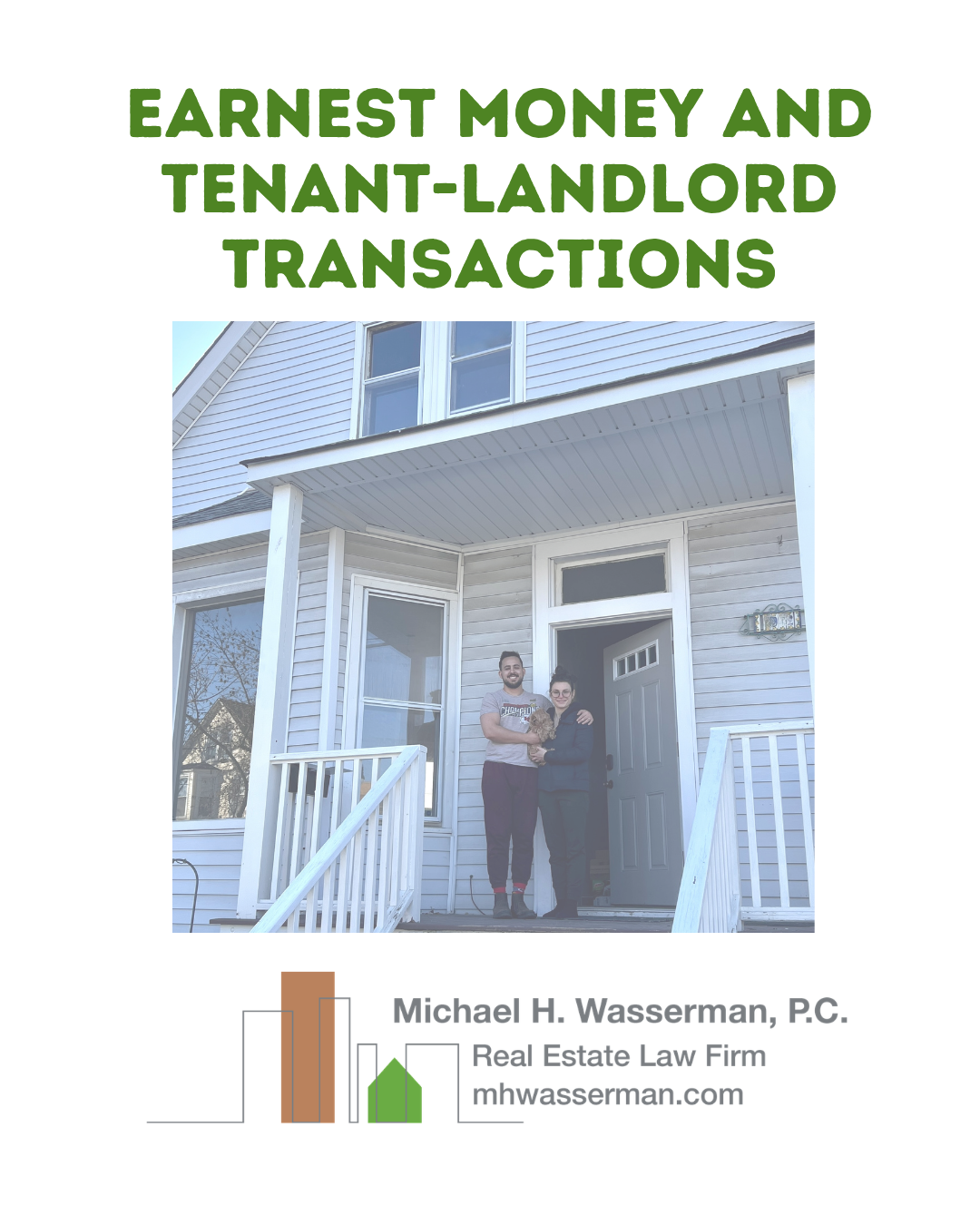
 Buying the home you rent from your landlord can be a tempting path to homeownership. You already know the property, the neighborhood, and the seller. And you won’t have to move.
Our firm has represented many tenants buy from landlords, and recently we've seen an uptick of these transactions. And we get a lot of questions, particularly about earnest money. Like these:
To see the anserse, scroll down or click the question.
Why is the landlord asking for an earnest money deposit?
Why must a tenant-buyer pay earnest money?
What is a reasonable earnest money amount?
Why is the landlord asking for an earnest money deposit? They already have my security deposit from my rental.?
We get asked this one a lot. Most tenants assume that the closing process should be simpler than a traditional sale. And in some ways, it is — you already know the seller and they already know you. You are already familiar with the property and the neighborhood. You have a history of monthly rent payments. But this question still comes up nearly every time: Do I really need to deposit more money?
The answer: Probably.
Go back up to Qs
Earnest money is a good-faith deposit to show you are serious about completing the transaction. It is not an extra fee.
That deposit is credited toward your purchase price or closing costs when the sale closes. And, if the deal falls apart for a contractually allowed reason (such as timely raised issues regarding home inspection, title, or financing), the money should be refunded to you. But these funds might be forfeited to the seller if you walk away from the transaction without a valid contractual reason.
Earnest money is to cover losses the seller may suffer as a result of your breaking the contract (aka default) and consequently not closing.
Why must a tenant-buyer pay earnest money?
Whether you must pay earnest money depends entirely on the purchase contract between you and your landlord.
There is no legal requirement that you must make a deposit at all, but there is also no legal exemption for tenants.
If you want to negotiate this point, it’s reasonable to ask about a reduced deposit or applying your existing security deposit toward earnest money. Your landlord may be flexible because they already know you and your payment history.
In our experience:
- A landlord may, on occasion, waive earnest money entirely, based on good faith and strong landlord/tenant relationships.
- But most sellers (including landlords) expect at least some earnest money deposit.
Go back up to Qs
What is a reasonable earnest money amount?
In the Chicago residential market, earnest money is typically expressed as a percentage of the purchase price. While every transaction is unique, common ranges include:
- 1% of the purchase price. Common for lower‑priced homes or when the parties already know each other (such as a tenant‑to‑buyer deal).
- 2%–5% of the purchase price. More typical in competitive markets or higher‑value properties.
- A flat amount. For example $1,000–$5,000, depending on the price point, are sometimes used in tenant purchases.
- You have a good track record of paying rent.
- They do not need to market the property or manage showings.
- The risk of buyer disappearance is lower.
Have more questions about earnest money? Click here to schedule a call with Mike Wasserman or John Aylesworth. Or ask us aboutbuying your placefrom the landlord. We're here to help.